Things You Must Know About Tirupathi Temple
By: Priyanka Maheshwari Wed, 06 Sep 2023 12:51:49
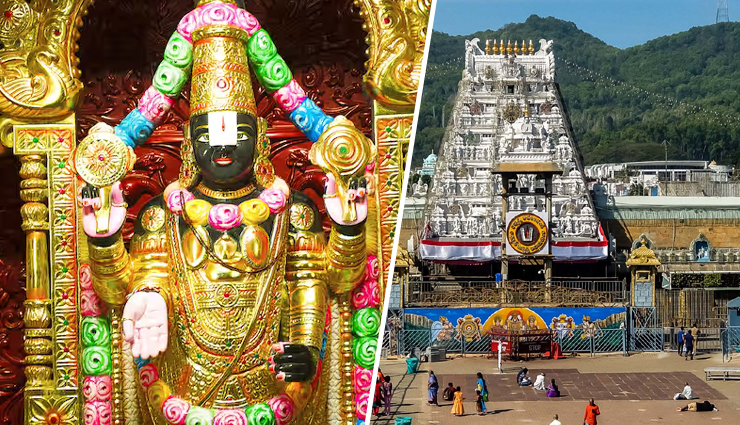
Nestled amidst the comforting embrace of Tirumala's seven hills, the Tirupathi Balaji temple stands as the embodiment of unshakable faith and profound spirituality. This sacred place holds a special significance as one of the revered Swayambhu Varaha Kshetras, where it is believed that Lord Venkateswara (Vishnu) manifested himself for the well-being of his devoted followers.
Referred to as 'The Temple of Seven Hills,' the Tirupathi temple has found mention in ancient Hindu Vedic scriptures and historical texts that date back centuries. The temple's mystical allure is further enriched by the distinctive shape of the Tirumala hills, which bear a striking resemblance to symbols associated with Lord Vishnu.
Within the temple's sanctum sanctorum, the majestic 8-feet tall idol of Lord Venkateswara stands, a symbol of the unwavering devotion of the millions of pilgrims who make their way to Balaji each year. From captivating legends to remarkable contemporary miracles, the Tirupathi temple has earned a reputation for its rich history and spiritual significance.
History of the Temple
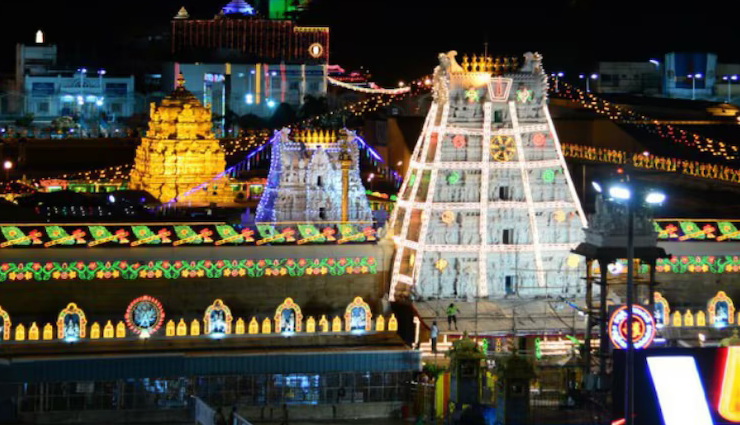
Throughout its long history, this ancient temple has witnessed the rule of numerous mighty monarchs spanning centuries. Within the temple's sacred precincts, approximately 1180 stone carvings hailing from diverse ruling dynasties, including the Cholas, Chalukyas, Achchuthan Rayar Dynasty, and Sadasiva Rayar, can be found.
The origins of the Tirupati temple can be traced back to around 300 AD, during the reign of King Thondaiman of the Tondaimandalam kingdom. Subsequently, various rulers and royal figures oversaw the temple's expansion and managed its affairs. Notably, Pallava Queen Samavati made a generous contribution by donating her precious jewels and 23 acres of land to the temple.
In later years, during the Chola dynasty, the temple was further developed and its wealth augmented. The Vijayanagara rulers, particularly Kriishnadevaraya, lavished the temple with numerous gold and diamond ornaments.
Following the decline of the Vijayanagara Empire, the East India Company assumed control of the temple's administration, leasing it to tenants for various purposes. Subsequently, the British transferred administration to the Hathiramji Muth, which cared for the temple until 1933.
Afterwards, the "Tirumala Tirupati Devasthanam" (TTD) managed the temple's administration for some years until a court decree transferred it to the Andhra Pradesh government in 1966. However, this order was reversed in 1979, leading to the formation of a committee comprising members from the government and the TTD trust. This temple committee has been responsible for overseeing the temple's day-to-day operations ever since.
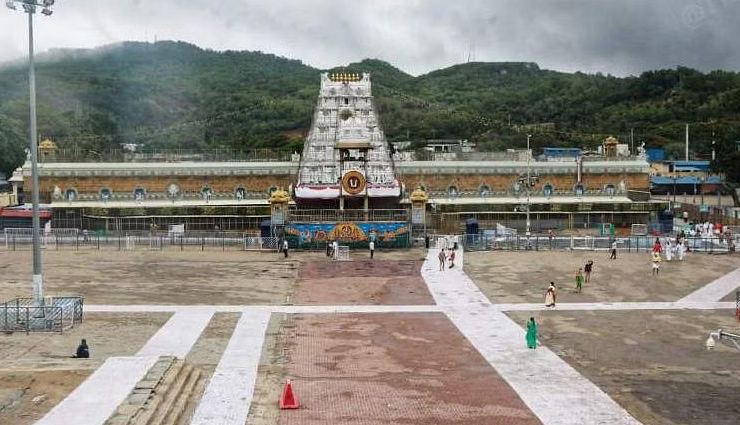
Stories Behind the Temple
The historical Tirupathi temple boasts a rich tapestry of legends associated with its origins. Among the most renowned narratives, one recounts an incident at the dawn of the Kali Yug era when Narad Muni, the divine messenger, posed a question to sages engaged in a Yajna ritual. He inquired about the worthiness of the three supreme deities—Vishnu, Shiva, and Brahma—to receive the Yajna's sacred fruit. Sage Bhrigu was chosen to assess the powers of these gods, but he went unnoticed by Lord Shiva and Lord Brahma during his visits.
Ultimately, when Sage Bhrigu approached Lord Vishnu, he was upset that Vishnu had not acknowledged his presence. In a fit of frustration, he kicked Lord Vishnu on the chest. However, Lord Vishnu responded with grace, politely apologizing to Sage Bhrigu and even massaging his feet as a sign of respect. This action inadvertently offended Goddess Lakshmi, who resided in Vishnu's chest. As a result, she left Vaikuntam (the Abode of Vishnu) and embarked on a meditation on Earth.
Overwhelmed by her departure, Lord Vishnu also chose to meditate on Earth, assuming a human incarnation known as Srinivasa. Upon learning of this, Goddess Lakshmi beseeched Brahma and Shiva to protect Srinivasa, and they assumed the forms of a cow and calf for this purpose. Goddess Lakshmi sent the cow and calf to a Chola king, who appointed a cowherd to tend to them. When the cow began to provide milk to Srinivasa on the hills of Tirumala, the cowherd became enraged and attacked Srinivasa. In response, Lord Vishnu cursed King Chola for the actions of his servant.
In his subsequent life, the Chola king had a daughter named Padmavati, whom he married to Srinivasa as an act of repentance for his earlier mistake. When Devi Lakshmi became aware of this development, she confronted Srinivasa in the presence of Padmavati. At that moment, Lord Vishnu transformed himself into an idol and remained in that form. Both Goddess Lakshmi and Padmavati chose to stay by his side, and today, they can be seen alongside him in the temple.
Architecture
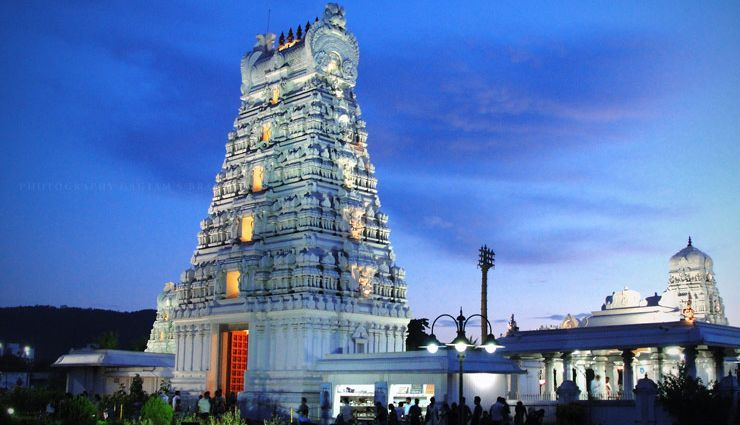
The Tirupathi temple stands as a splendid exemplar of the Dravidian architectural style, crafted with remarkable skill using materials such as granites, sandstones, and soapstones. The temple complex features three entranceways, each adorned with multi-storied Gopurams, or ornate temple towers, gracing their summits. Within the heart of the temple lies the Sanctum Sanctorum, known as the AnandaNilayam, where Lord Venkateswara is enshrined, facing eastward.
Encircling the Sanctorum, there are two circumambulation paths, referred to as Pradakshinam, which serve as spaces for religious rituals. Along these paths, numerous Mandapas and subsidiary shrines pay homage to various Hindu deities. Within the temple grounds, two contemporary queue complexes have been established to accommodate pilgrims and provide them with sustenance. Additionally, the temple precincts house facilities for hair tonsure, a customary practice, as well as accommodations for pilgrims.
Religious Significance
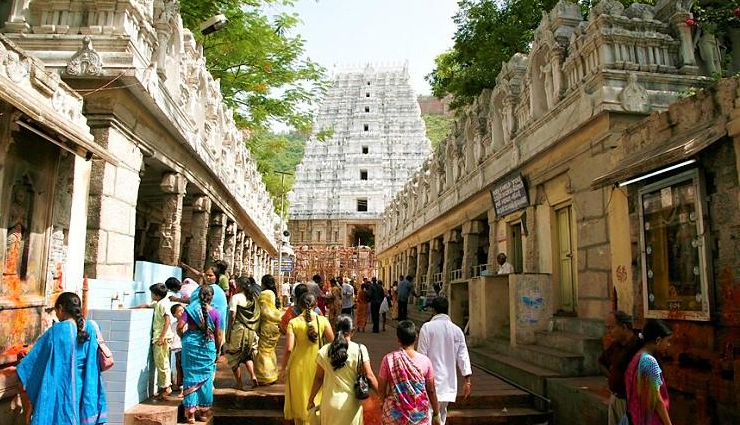
The Tirupathi temple stands as India's most frequented sacred site, welcoming an approximate daily influx of nearly 50 thousand devoted pilgrims. It holds a unique status among the eight revered Swayambhu Kshetras, where it is believed that Lord Vishnu spontaneously manifested himself. The Tirupathi Balaji temple is prominently featured in various Hindu scriptures and Vedas, commanding profound reverence from Hindu worshippers.
This revered temple is also counted among the 108 Divyadesam, Vishnu temples of great significance documented in religious texts. The rewards of embarking on a pilgrimage to the Venkateswara shrine are detailed in the Asthadasa Puranas and the Rig Veda, extolling the presiding deity, Lord Venkateswara, as the bestower of all blessings.
The Alwars, characterized as supreme devotees of Vishnu, have sung prolifically in praise of Lord Venkateswar. Devotees firmly believe that Lord Venkateswar has taken residence in this shrine to cleanse the world of its ills during the era of Kali Yug. It is widely held that those who worship the Lord with unwavering devotion will have their desires granted as a divine blessing.
Festivals and Religious Ceremonies
The Tirupathi temple adheres to the "Vaikhanasa Agama" worship tradition, which places Lord Vishnu as the supreme deity. Within the temple, a variety of daily Sevas (religious services) are conducted by the priests, encompassing rituals such as Suprabhata Seva, Archana, Thomala Seva, and more. Additionally, the temple incorporates several weekly and periodic Sevas as integral parts of its religious customs.
In addition to the routine Poojas (ritualistic offerings), the temple observes numerous annual festivals with great grandeur. Among these, the Sri Venkateswara Brahmotsavams takes center stage as a nine-day extravaganza celebrated in October. During this festive period, the deity Malayappa, accompanied by his consorts Sridevi and Bhudevi, is ceremoniously paraded around the temple grounds.
Another significant event in Tirupathi is Vaikunta Ekadasi, a celebration associated with the belief that the Vaikuntha Dwarams (doors to Lord Vishnu's abode) open on this day. It is marked with splendid festivities. Additionally, the Rathasapthami festival holds importance in Tirumala traditions and is celebrated in February. During this festival, Malayappa is once again taken on a procession, this time on seven distinct Vahanams (vehicles), from morning until night.
The temple administration is responsible for organizing more than 400 annual festivals in Tirupathi, including events such as Rama Navami, Ugadi, Pushpa Yagam, Vasanthotsavam, Teppotsavam, Janmashtami, and numerous others.
Stories of Miracles
In addition to its captivating spiritual aura, the Tirupathi temple also holds a rich tapestry of miraculous and enigmatic tales. Numerous devotees attest to having experienced unexplainable wonders attributed to the divine blessings of Lord Venkateswara. One particularly renowned mystical narrative associated with Tirupathi dates back to 19th Century India.
Legend has it that during that era, the ruler of the Tirumala region had decreed the death penalty for twelve individuals convicted of grave offenses. These twelve individuals were executed, and their lifeless bodies were left hanging on the walls of the Tirupathi temple. Many assert that during this period, the deity manifested in some form, and subsequently, the temple remained closed for twelve years.
Another puzzling phenomenon unfolds within the precincts of Tirupathi, a mystery that eludes explanation. The idol of Balaji consistently maintains a high temperature of 110 degrees Fahrenheit, even in the midst of the chilly surroundings. Devotees recount that each morning, following the holy bath of the deity, priests observe tiny beads of sweat forming on the idol. These perspiration droplets are gently wiped away by the priests using silk fabrics. Furthermore, on Thursdays, when the priests remove the ornaments from Balaji for the Abhishekam ritual, the jewelry exudes a sensation of warmth, as if they have been taken from a living entity.